Categories

FOLLOW US ON TWITTER


Archives

  • 2010
  • 2009
  • 2008
  • Archive for February, 2009

    All About Preschoolers

    preschool
    Children grow so fast physically and mentally, and every day that comes brings something new into your child.  As a parent, I try to keep up with these changes in my child; for me this is what makes parenting thrilling.  To learn more about my preschooler, it is not only him that I observe. I also observe other kids–his playmates.

    I learned that children three to five years old  begin to socialize; they become more interested in other children and start to value friendship. I am not really sure about how much they understand about the complexities of things like friendship, but I know that at this age they already understand the beauty of sharing, and that other people have feelings and rights that need to be respected.

    Preschoolers are increasingly independent and probably can do chores like dressing, with little help. They also can understand and follow spoken directions. At this age kids also gain better motor skills, it shows in their drawings and scrawls which are by now finer. The imaginations of children at this age also become sharper and stronger. It is during this time that they could develop fears like imagined monsters lurking in the dark. Parents should know how to handle this.

    Because they have greater large-muscle control than toddlers, preschoolers  are more active and love to run, jump, skip, climb things, and dance. My little boy is always all over the house, and at times it feels like there are a dozen of him running around.

    Preschoolers recognize the letters of the alphabet and know how to match and sort things that are similar and dissimilar. They also recognize humor and practical jokes.  This is the best time to teach them the the necessary things that become the strong base for their education. It is also during this time that they start to become good at picking up what adults say, which is why parents should be careful about what they say to their preschoolers.

    Post to Twitter Tweet This Post

    Why Infants Shouldn’t Eat Honey

    honey
    You may have been told or read about how you should not feed infants honey. Some of you may have questioned this, while others may have added this to a new line of the already lengthy list of foods you should not feed your baby.

    So, why should you not feed infants under the age of one this delicious natural sweetener?  Well, feeding your baby honey could put your child at risk of infant botulism. What is botulism? According to wisegeek.com,  ”Botulism is a type of paralytic illness which is often caused through consumption of contaminated food.” In simple terms, it is food poisoning. Though the disease is very rare, (around 100 cases of the illness are reported to the CDC per year), it is a very serious disease that could be fatal if left untreated. However, as one would assume, it would be wise to avoid illness as much as possible.
    Botulinum spores are found throughout nature or in other sweeteners, such as maple syrup or corn syrup, but honey seems to harbor them the most. If you want to feed your child honey, buy pasteurized honey.

    What are the symptoms of botulism? The earliest sign of this disease is constipation. The child also will exhibit nervous system damage, which is displayed as muscle weakness. Your child will seem limp, lethargic, will cry more weakly, have difficultly feeding, and more.

    Try to avoid putting your child at risk, but if you do notice any of these symptoms, please seek medical help immediately.

    Post to Twitter Tweet This Post

    When Your Preschooler Misbehaves Intentionally

    Parenting would be a lot easier (and less exciting) if we remembered how exactly our minds worked when we were between the ages three and five. But it’s not how things are and we parents have to struggle (happily) daily to try to read our children’s minds.
    misbehave
    I have noticed lately that my three year old son (he turns four this coming April) is into misbehaving intentionally. It is as if he is testing his parents’ limits. Every time he succeeds in doing something dangerous without being hurt or without being rebuked, he will proceed to doing something even more dangerous and see how his parents react. I react to these behaviors by trying to introduce a different activity, something that is milder and  safer. This technique usually works. My wife has a different approach; she shows our son that she is the disciplinarian and reprimands him and set limits to his actions. Her technique is also effective especially when my style fails to work at times.

    There are many reasons why children misbehave, and the reasons vary from one child to another.  It is important for parents to discover the reason for their child’s misbehaving. The usual reason could be the desire of the child to get attention. Children who do not get enough positive attention try to find ways to get it, and when they do not get it, they settle for anything, even negative attention will do. Sometimes we misinterpret the playfulness of a very active child as misbehavior. Parents should learn to discern the difference between what is real misbehavior and what is playfulness.

    Reacting in a harsh way, like yelling at the child or hitting the child, is not advisable because it is a sign that you are getting out of control, and the child will clearly see this. One of the greatest challenges to parents is how to keep cool when meting out punishment. Rewarding good behavior is always better than giving punishment for bad behavior. Spending as much time as possible with your child will help minimize the chances of your child misbehaving in order to get attention. A child who knows that he is being loved and taken care of rarely misbehaves.

    Post to Twitter Tweet This Post

    Board Games for the Family

    My family is really big on playing board games. It is definitely the best way for us to get together and interact, a completely different experience from watching a movie together. Maybe there is someone in your the family who claims to hate board games, but it might be because he or she hasn’t played the right ones. Contrary to what it may seem like, there are more board games out there besides the standards: Life, Clue, checkers, and Monopoly. Imagine!
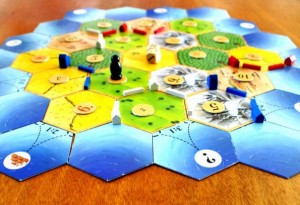
    It can be an unusually difficult process to buy a board game that is outside of the familiar zone. It’s hard to know, if you’ve never played it before, if the game worth the investment. BoardGameRatings.com is a very reliable Website for just that purpose. Recently I was looking to buy a new board game, and this is the Site I came across. I looked at their picks for the best game, and at the top of the list was my favorite game of all time: Settlers of Catan. Right away, this site gained some trust from me.

    I took a look at what kind of information they provided, and the game family-board-gamedescriptions are extremely thorough. They provide ratings for the amount of luck, strategy, knowledge, creativity, interaction, and complexity involved. They were spot-on for Settlers of Catan. Additionally, there are user comments and ratings so you know the opinions just aren’t coming from a biased company.

    Board games can be expensive, but when you find one that your family enjoys, they are more than worth it. My family first played Settlers of Catan in Holland, and we brought a version back to America. There is, of course, an English version, but we stuck with the Dutch version. Since we love it so much, we’ve taught over a dozen of our friends enough Dutch so they can play too! We also bought an expansion pack that increases the original game from 4 to 6 players.

    Post to Twitter Tweet This Post

    Bidding for Chores

    As parents, my husband and I have had a few discussions about allowances.  To me, they always have seemed problematic.  If you simply give your child money, it seems that he would learn to expect that money be given always.  If you attach the allowance to chores, your child can choose not to do chores that you expect to have done.   Therefore, we have created our own system, which is working nicely with our tween-aged children.

    boy
    First, we have created a list of chores that are expected to be done without pay, simply because they are  members of our family.  For every household, these chores could differ, but in our home, they are: emptying bathroom trashcans on trash day, taking out or bringing in garbage cans on trash day, putting away silverware after washing, putting away own laundry, bringing dirty laundry to washer.

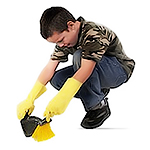
    Second, on a weekly basis, I create a list of other chores that I need to have completed and that can be done by our kids.  These include (but aren’t limited to): sweeping floors, sweeping the garage, dusting furniture, vacuuming rooms or sets of stairs.  Once the list is ready, the bidding begins.

    Here are our rules for bidding:

    1. If a bid is deemed too high, it does not have to be accepted by the  parent.
    2. Once a bid is accepted that child needs to complete that chore before returning to play, etc.
    3. A chore is determined to be complete by the parent.  Poorly done chores need to be redone.
    4. A child receives pay for chores once all of her chores are completed.
    5. Bids must be made in 5 cent denominations.

    In addition to earning money and having a clean house, this system has other advantages.  Our children have learned the value of money.  Through bidding too low for a chore and completing work, they are gaining a better understanding of what things are worth.  They also are learning to take initiative.  Although I complete the chore list, they have made suggestions for other chores that they could complete, which helps reduce our (the parents) workload and provide more income for the kids.  Finally, they are learning to manage time.  Although, one child could try to offer low bids on all chores, it would take a greater amount of time.  Typically, they find a way to bid so that they receive a similar amount of work and/or money.

    Bidding for chores has solved our allowance dilemma, providing some extra money for the kids and some extra time for the adults.  It has been a win-win in our home.

    Post to Twitter Tweet This Post

    Parenting Videos

    YouTube Preview Image

    Post to Twitter Tweet This Post


    Kids left you broke? Visit the IVA Forum for iva help and advice.

  • Friends